SINGLE SKIN AND BUNDED TANKS
In times past, heating oil tanks were simply inanimate, large, hollow objects, which stored oil. Indeed, their basic design remained unchanged for decades. But fast forward just a few years and product innovation has changed everything.
Estimated Reading Time: 7 minutes
Advances in boiler technology now allow you to choose, between an outlet positioned at the top of the tank, and an outlet positioned at the bottom. You’ve a choice of overfill prevention technology too. And of course, you can choose between an old-fashioned single skin*, or an environmentally preferred, bunded tank. Double-skinned and underground models are also available. This section focuses upon aboveground tanks.
Single Skin Oil Tanks
A single skin tank consists of a steel or plastic container used to store oil, and which features no secondary containment whatsoever. So, unless placed within a suitably bunded area, should a spill occur, spilt fuel will be discharged to the environment, and an environmental pollution incident will occur.
That’s why single skin tanks today, are suitable only for installation within a suitably bunded area, or at the very small number of remaining installations where a bunded tank is not yet a legal requirement.

A Carbery 1100R Single Skin Heating Oil Tank. Photo Credit: Carbery Plastics
Installing a single skin tank where a bunded tank is legally required is a serious offence.
Before choosing a single skin tank, a risk assessment must be completed by a competent, storage tank technician, to examine the likely impact of a spill upon the environment. Even where a single skin tank may today suffice, consideration should always be given to installing a bunded tank, in anticipation of possible, future, regulatory change.
Bunded Oil Tanks
Unlike single skin models, a bunded tank consists of a tank within a tank.
The inner tank is the primary storage container, whilst the outer tank or ‘bund’, acts as a failsafe. It can contain 110% of the volume of the inner tank. Should a spill occur, spilt fuel will be safely and securely contained within the outer tank, and the risk of an environmental pollution incident, significantly reduced.
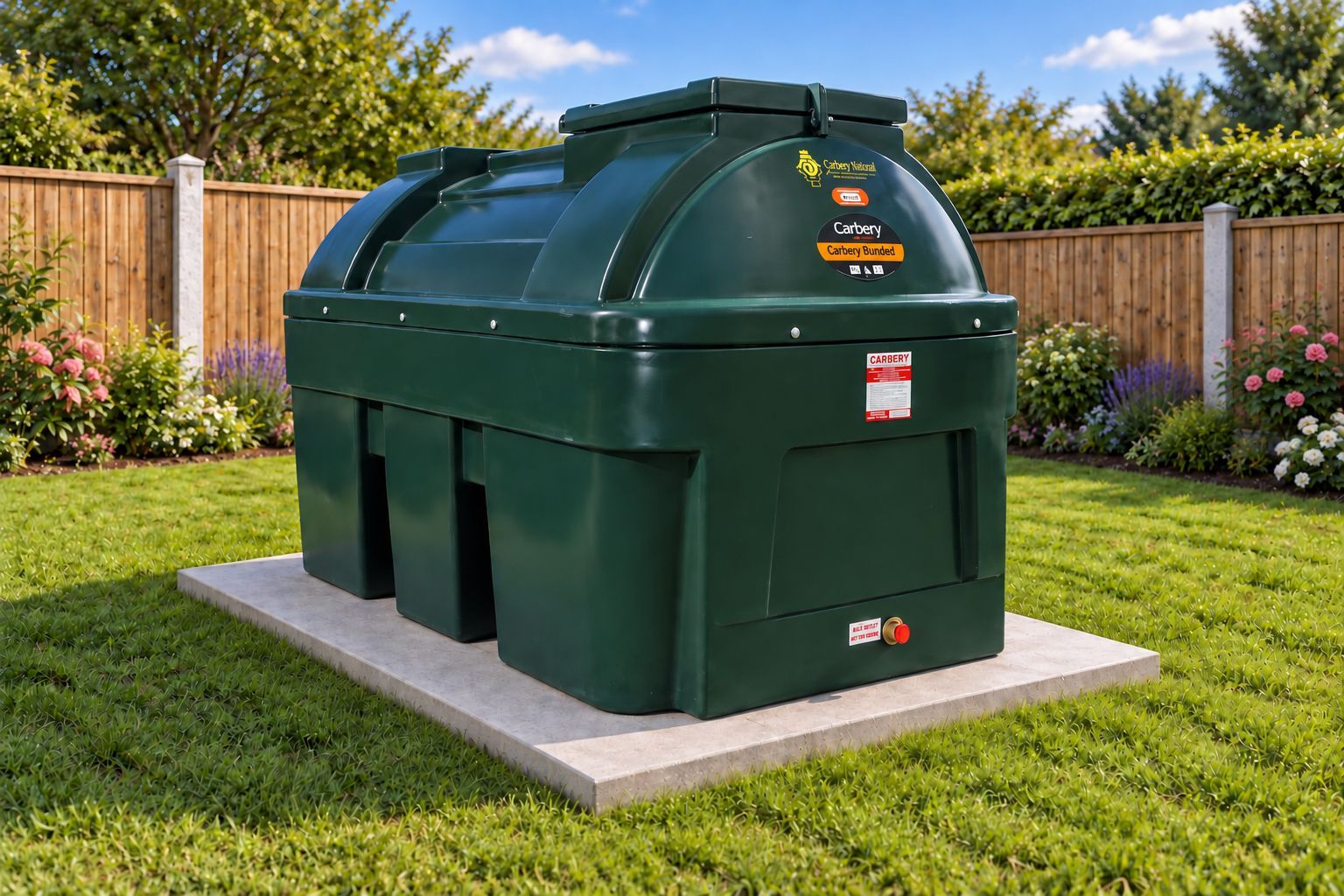
A Carbery 1350HB Horizontal Bunded Heating Oil Tank. Photo Credit: Carbery Plastics
Bunded tanks are proven to substantially reduce the likelihood of an environmental pollution incident. Today, they are a legal requirement at almost all heating oil storage installations. So, if you’re considering the installation of an uncontained, single skin tank, beware… you’re almost certainly installing the wrong tank, in the wrong place.
Whilst bunded tanks do cost more than single skin tanks; the additional cost is a small price to pay. Clean-up costs for even a small spill may run into many thousands. Furthermore, oil spills are not always covered by home insurance policies. Should a spill occur, you may incur significant legal expenses, potentially a fine, and a victim surcharge. Even at the few installations where a single skin tank may currently suffice, consideration should always be given to installing a bunded tank to minimise the risk of damage and loss.
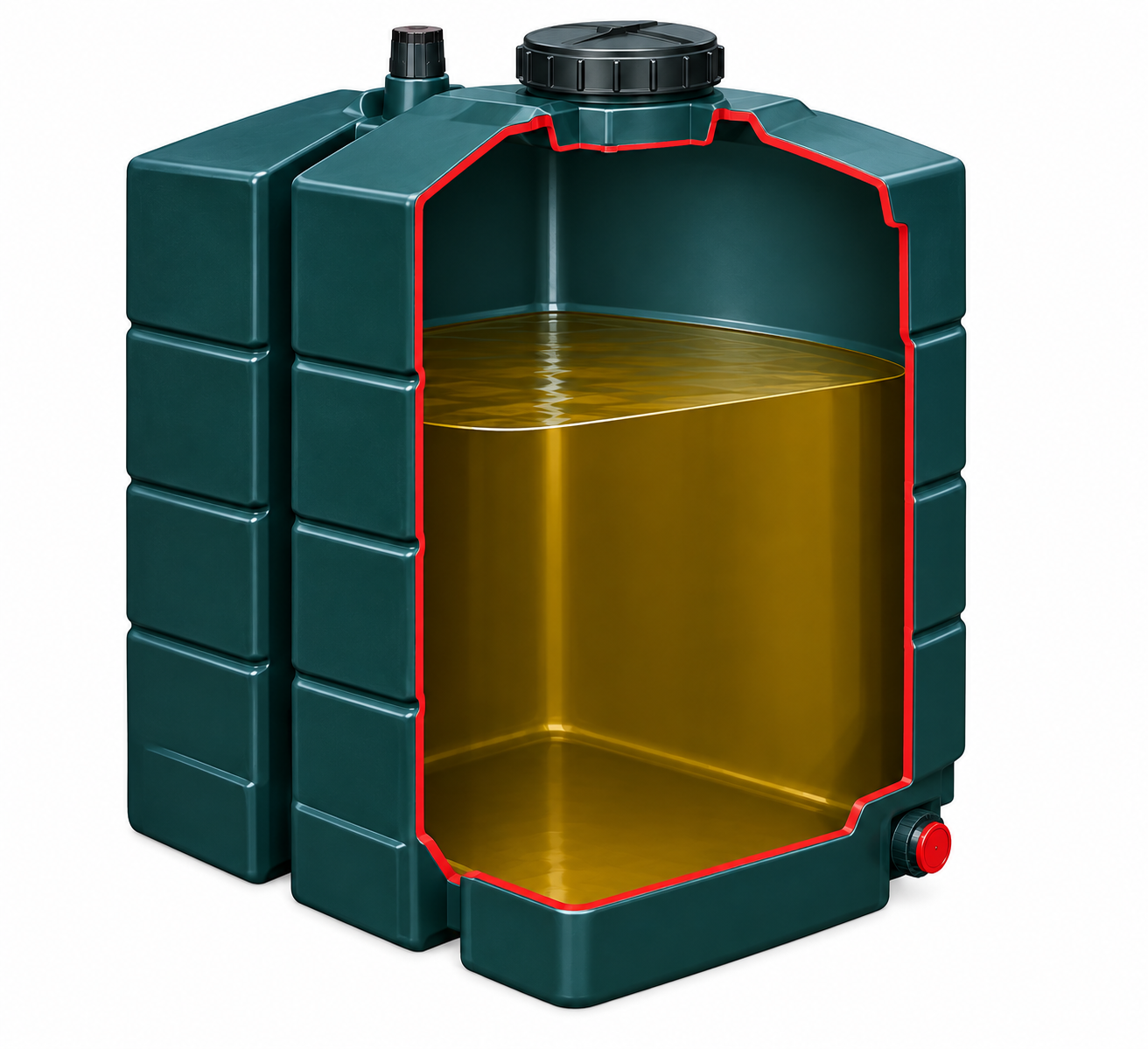
Single Skin Heating Oil Tanks incorporate no secondary containment whatsoever. Image Credit: Author
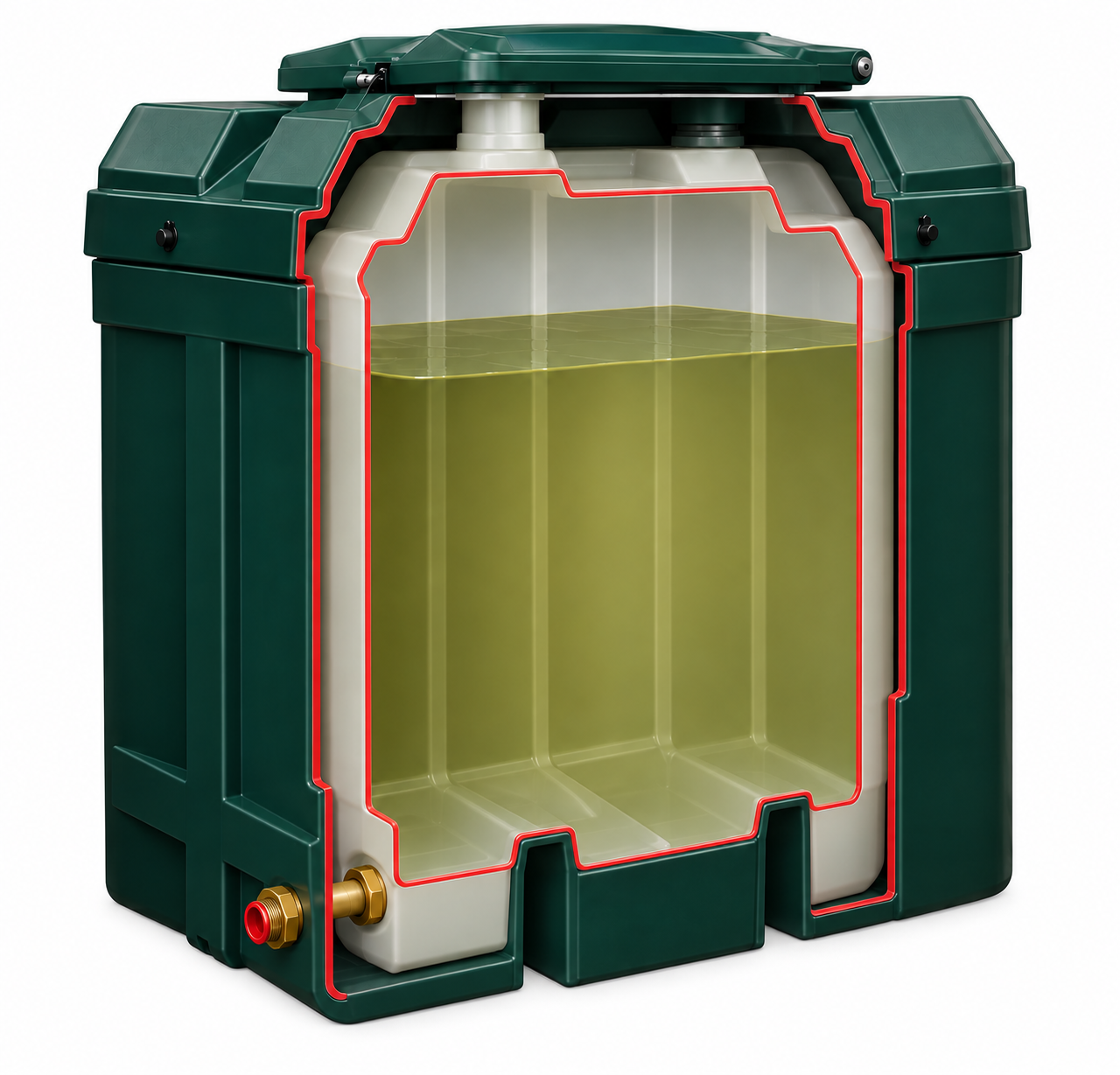
Bunded Heating Oil Tanks comprise an inner tank, placed inside an outer tank or 'bund'. Image Credit: Author
Double Skinned Tanks
As well as single skin and bunded tanks, double skinned aboveground tanks are also available. When designed for installation aboveground, they typically comprise a plastic inner tank, with a steel or aluminium outer tank.
However, unlike bunded tanks, the outer tank does not always contain 110% of the inner tank's capacity. Double-skinned tanks which do not meet this capacity threshold, and which are not specifically designed for belowground installation, must be placed within a suitably bunded area.
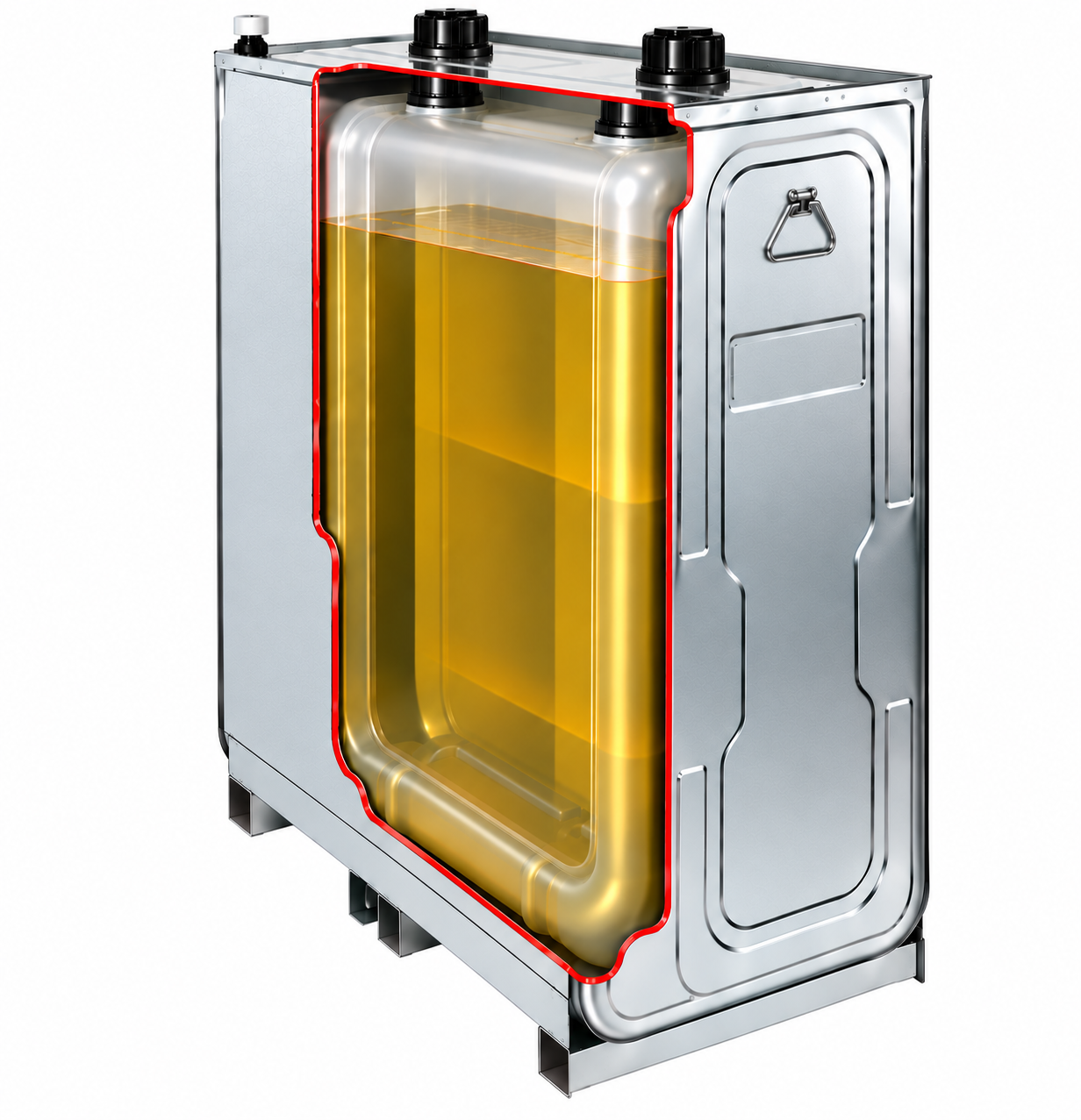
Cut-away of a double skin tank, showing the absence of a bund, between the inner and outer tank. Image Credit: Author

Cut-away of a typical masonry bund, incorporating a single skin heating oil tank. Image Credit: Author
Masonry Bunds
An alternative to purchasing a manufactured bunded tank is to construct a masonry bund and then place a single skin tank within it. Constructing a compliant masonry bund requires much more than simply laying down a concrete pad and constructing a block wall.
Instead, detailed guidelines for the construction of masonry bunds exist e.g.
CIRIA Report No. 736 'Containment systems for the prevention of pollution'. So, if you’re considering the construction of such a bund, you’ll need to take expert advice. Whilst masonry bunds are often found at large commercial fuel storage installations, at domestic premises, a regulatory compliant masonry bund, will frequently prove cost prohibitive.
To Bund or Not to Bund?
To determine whether it’s necessary to fit a bunded tank, an on-site risk assessment must first be undertaken. This assessment should only be completed by an independently accredited technician, such as a suitably qualified installer, registered with The Association of Plumbing & Heating Contractors (APHC), or The Oil Firing Technical Association (OFTEC). Typically, a risk assessment considers the threat posed to the environment by a spill from the tank, and poses a series of questions, similar to those below:
Environmental Risk Assessment
To be completed only by a suitably competent person, prior to the installation of a new or replacement Heating Oil Storage Tank.
- Is the total installed oil storage capacity of all tanks on-site greater than 2,500 litres?
- Will the tank be positioned within 10 metres of controlled water?
- In the event of a spill from the tank, could fuel enter a drain or unsealed manhole cover?
- Is the tank located within 50 metres of a well, borehole or spring?
- Will the tank be positioned over hard or hard surfaced ground that would allow a spill to reach controlled water?
- Is the tank located in a position where the vent pipe is not visible from the fill point?
- Will the tank be supplying fuel to a building other than a dwelling occupied by a single family?
- Is the tank located in a Groundwater Special Protection Zone?
- Are there any other site-specific risks or hazards, including but not limited to ditches (whether wet or dry), septic tanks, effluent treatment systems, soakaways and/or gullies?
- Is the tank installed in Wales?
- Will the tank be used to store Hydrotreated Vegetable Oil (HVO)?
If the answer to any question in the risk assessment is ‘Yes’, ‘Maybe’, ‘Possibly’, ‘Probably Not’ or ‘Unsure’, then a bunded tank must be fitted.
If the answer to every question is a definite ‘No’ then in some, limited circumstances, it currently remains permissible to fit a single-skin tank... but proceed with an abundance of caution. During the past 25 years of working in the industry, we've only come across a handful, where a single skin oil tank would be permissible.
Additional Considerations
When completing the risk assessment, it's important to note:
- ‘Controlled Water’ will feature prominently in any environmental risk assessment. It’s simply an umbrella term to describe streams, lakes, loughs, lochs, ponds, canals, coastal waters, estuaries and groundwater. It refers too, to all water which is below the surface of the ground in the saturation zone, and in direct contact with the ground or subsoil;
- Regional variations may apply, which may mandate the installation of a bunded tank. For example, since 15th. March, 2016, when the Control of Pollution (Oil Storage) (Wales) Regulations 2016 came into full effect, virtually all new and replacement aboveground heating oil tanks installed in Wales must be bunded;
- Warranty implications of fitting a Single Skin Tank, where a Bunded Tank is required, must also be considered. Some manufacturers of single-skin tanks also specify their products are suitable for installation only within a suitably bunded area. Install the tank outside a bunded area and you’re installing the wrong tank, in the wrong place, and likely voiding any warranty supplied.
Our Take...
When installing a new tank, or replacing an existing tank, we only recommend the installation of a Bunded Tank, in light of current and potential future regulations. Fitting the wrong tank, in the wrong place, can prove an expensive mistake.
Yes, a Bunded Tank does cost more than Single Skin Tank. However, the premium has diminished markedly over the past decade. Besides which, if you think a Bunded Tank is expensive… just wait until you have a spill. Furthermore, with the advent of Hydrotreated Vegetable Oil (HVO) as a mainstream liquid fuel solution – a fuel which is inherently unsuitable for uncontained Single Skin storage – fitting a Bunded Tank today, can futureproof your heating system for the fuels of tomorrow.
* Subject to prevailing statutory requirements. An environmental risk assessment must be completed, by a suitably competent person, such as an APHC or OFTEC registered technician, prior to the installation of any Single Skin Tank.
Header Photo Credit: Carbery Plastics