A MATERIAL DIFFERENCE
Not so very long ago, when choosing a tank, you typically had a choice of no more than two or three capacities. All were made from steel, typically manufactured by a local fabricator, using a process, whose origins could be traced back to the industrial revolution. But with the increasing popularity of plastic tanks, today things are very different.
Estimated Reading Time: 4 minutes
When choosing a new tank, the first question many people consider is, ‘Should I choose a steel tank, or opt instead for a plastic tank?’ Most heating oil tanks sold today are rotationally moulded, plastic tanks. Rotational moulding is a long-established manufacturing process. It produces largely unstressed products with excellent impact and chemical resistance properties - making it ideal for the manufacture of oil storage tanks.
Rotational Moulding
Most plastic oil tanks in Great Britain and Ireland today are rotationally moulded. The process (often referred to simply as 'rotomoulding'), involves placing a plastic material - usually a specialist grade of Medium Density Polyethylene (MDPE) - into a hollow mould, fabricated from mild steel.
The mould is then slowly rotated on two perpendicular axes inside a large oven, so that the softened plastic evenly coats the interior of the mould, forming a hollow part. After heating, the mould is cooled, allowing the plastic to solidify, before the moulded product is removed.
The photograph shows a 2,500 litres capacity heating oil tank mould, about to be placed inside an oven, at Carbery Plastics' rotational moulding centre of excellence, in Clonakilty, West Cork.

Plastic heating oil tanks were pioneered in the 1970s by UK manufacturer, John Tyrrell Tanks Limited, based in Portadown, Co. Armagh. At that time, almost every heating oil tank was manufactured from mild steel. Within a decade, brand names such as Ar-Met, Carbery and Titan had appeared, and plastic tanks were a firm fixture in the fuel storage sector across Great Britain and Ireland. Today, British and Irish manufacturers are world leaders in the design, development and manufacture of rotomoulded tanks.
Yet, despite the continuing popularity of plastic tanks, steel tanks continue to remain available. They are usually manufactured by welding lengths of sheet steel together. The resulting tank is then coated or painted, to reduce the risk of corrosion. Whilst steel tanks today account for only a minority of domestic heating oil tanks, they are still a popular choice at larger commercial, industrial and institutional fuel storage installations.
Plastic or Steel?
So, what’s the best choice for your home? Steel or plastic? The simple answer is that each type of tank has its own merits and drawbacks. The ideal choice for your home will depend upon your lifestyle, your budget and location. To help you decide, we’ve listed some of the benefits and disadvantages of each material below:
- Plastic tanks are corrosion resistant and will not require painting;
- Steel tanks tend to corrode from the inside – so no matter how good they may appear on the outside, you can’t easily tell their condition on the inside. Most steel tanks will also require repainting periodically;
- Whilst steel tanks are available in a much greater range of sizes and capacities than plastic tanks, the flexibility of the rotational moulding process ensures plastic tanks are available in a wider range of shapes and designs;
- Many steel tank manufacturers can construct tanks to specific dimensions on a ‘made to order’ basis – a service that simply isn’t available from most plastic tank manufacturers;
- Plastic tanks are lighter than steel tanks. This makes plastic heating oil tanks easier to handle, transport and install;
- Plastic tanks are manufactured from a chemically inert polymer, whereas steel tanks will often react with the oil stored inside them. This creates a toxic sludge, which must be removed periodically and disposed of responsibly;
- Whilst a smaller capacity plastic tank might prove cheaper than a steel equivalent, larger capacity plastic tanks are frequently more expensive than an equivalent steel model;
- Because steel tanks can be easily painted,
you can colour match almost any steel tank to the environment in which its installed. By contrast, plastic heating oil tanks are almost always green in colour. Usually,
plastic tanks cannot be painted.
- Plastic tanks are corrosion resistant and will not require painting;
- Steel tanks tend to corrode from the inside – so no matter how good they may appear on the outside, you can’t easily determine their condition. Most steel tanks will also require repainting periodically;
- Whilst steel tanks are available in a much greater range of sizes and capacities, the flexibility of the rotational moulding process ensures plastic tanks are available in a wider range of shapes and designs;
- Many steel tank manufacturers can construct tanks to specific dimensions on a ‘made to order’ basis – a service that simply isn’t available from most plastic tank manufacturers;
- Plastic tanks are usually lighter than steel tanks. A lighter tank is easier to handle, transport and install;
- Plastic tanks are manufactured from a chemically inert polymer, whereas steel tanks will often react with the oil stored inside them. This creates a toxic sludge, which must be removed periodically and disposed of responsibly;
- Whilst a smaller capacity plastic tank may prove more affordable than a steel equivalent, larger capacity plastic tanks are frequently more expensive than an equivalent steel model;
- Because steel tanks can be easily painted, you can colour match almost any steel tank to the environment in which it's installed. By contrast, plastic heating oil tanks are almost always green in colour. Usually, plastic tanks cannot be easily painted;
- Plastic tank warranties can sometimes be longer, than warranties supplied on steel equivalents.
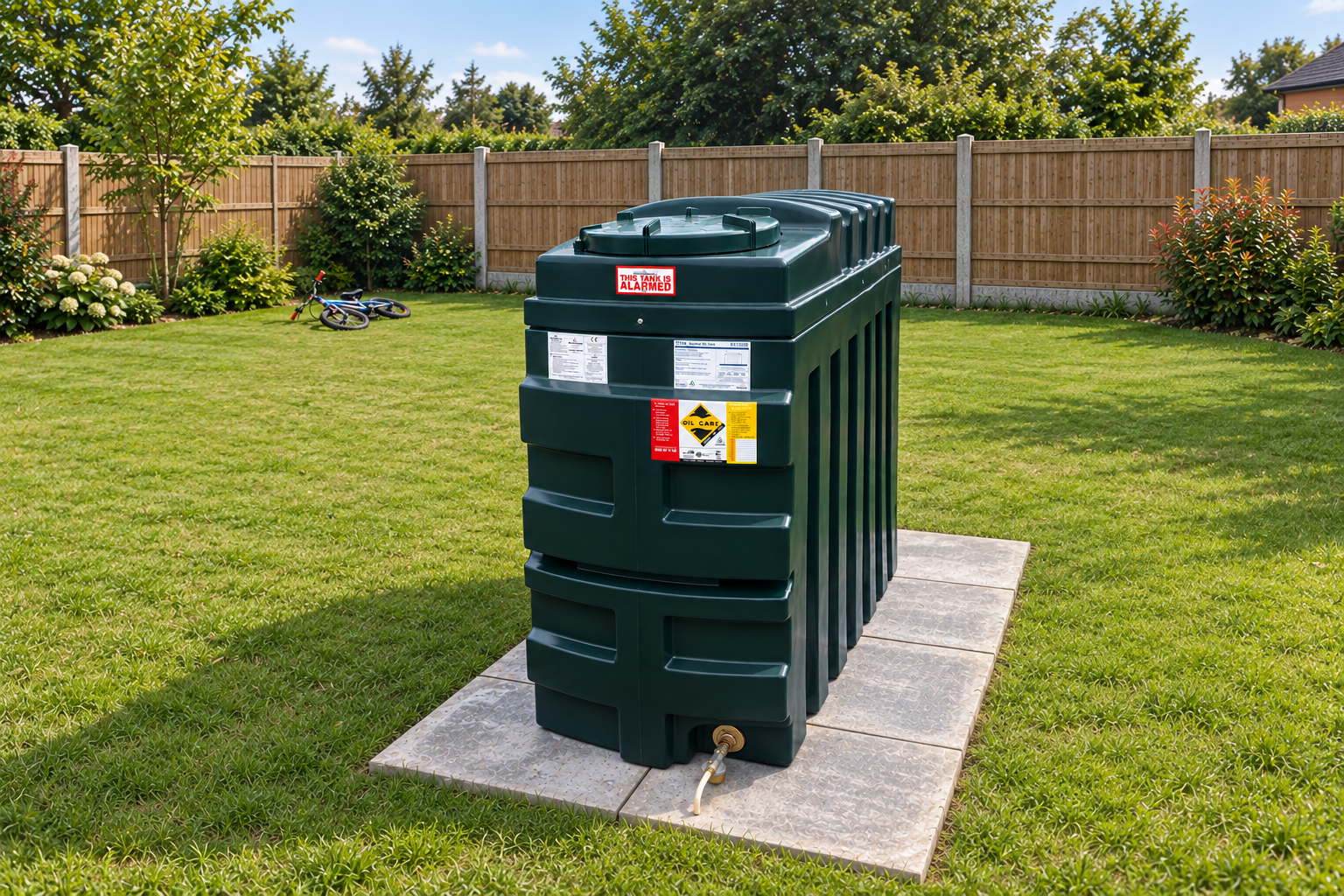
Plastic tanks today account for the majority of domestic oil tank sales in the UK and Republic of Ireland. Image Credit: Author
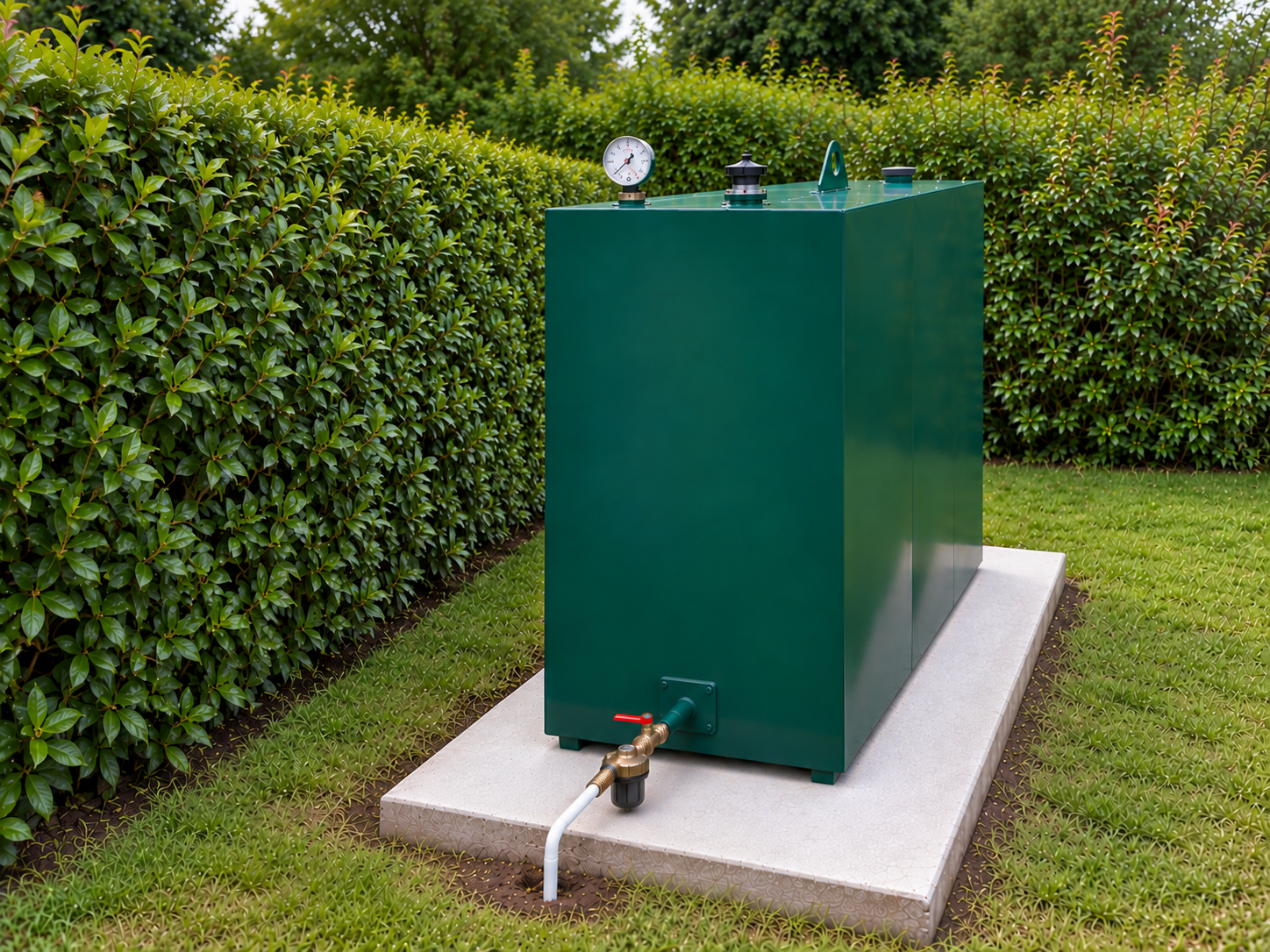
Despite the continued popularity of plastic tanks, there's still a very definite place for steel tanks today. Image Credit: Author
Hybrid Tanks
As well as plastic or steel tanks, hybrid tanks are also available.
Typically, a hybrid tank comprises a rotationally moulded, plastic inner tank, placed inside a steel outer tank or ‘bund’. From the outside, they're pretty much indistinguishable from a regular steel tank. Manufacturers claim hybrid tanks combine the durability of plastic with the strength of steel but are frequently more expensive than both. So, whilst hybrid tanks can sometimes be found storing diesel at industrial premises and on some construction sites, they are rarely found at domestic heating oil storage installations.
Our Take...
Affordable, corrosion resistant, and with lower maintenance requirements than steel, plastic tanks are the ideal choice for the storage of heating oil at most residential installations. However, if you require a bespoke tank to accommodate a specific installation or wish to colour match your tank to its surroundings, you'll almost certainly want to take a closer look at steel alternatives.
And, if you’re unsure whether to choose a steel tank, a plastic tank, or even a hybrid tank, why not speak with friends or neighbours who use heating oil, and ask for their experience? Your local fuel distributor and heating oil tank installer will also be able to help.
Header Photo Credit: Carbery Plastics