INSTALLATION
Any tank can only ever be as good as its installation. And any installation can only ever be as good as its installer. Oil tanks cannot be installed anywhere, by anyone. Instead, the installation of domestic oil storage tanks, is subject to strict regulation.
Estimated Reading Time: 8 minutes
Arguably the most important factor in any heating oil storage installation is the person who installs it. Heating oil tanks are not suitable for DIY installation and instead must only be fitted by a competent, professional installer.
Choosing an Installer
The Association of Plumbing & Heating Contractors (APHC) and The Oil Firing Technical Association (OFTEC) are both authorised by HM Government to operate a Competent Persons' Registration Scheme for the installation and maintenance of heating oil tanks.
Irrespective of where you live, when choosing an installer, it's recommended you choose a suitably qualified technician, registered with a Competent Persons Scheme. You can find your local APHC Registered Technician by visiting www.aphc.co.uk, and your local OFTEC Registered Technician, by visiting www.oftec.org
An installer who is a member of a Competent Persons Scheme in England and Wales, such as those operated by APHC and OFTEC, is authorised to self-certify that their work complies with all local building regulations and standards. They can also undertake specific works without needing to first submit a building control notice. As a result, local authorities will not need to inspect their work, which can save you time and money. Such provisions do not however apply to installations completed in Northern Ireland, the Republic of Ireland or Scotland.
When choosing a technician, insist upon seeing identification, that proves their membership of a Competent Persons Scheme. You can verify registration by contacting the Competent Persons Scheme operator or visiting their website, quoting the technician’s name or registration number. We'd always recommend seeking, and reviewing customer testimonials too.
Location
Heating oil tanks can’t be sited just anywhere, or installed by simply anyone. To reduce the risk of fire and pollution, building standards and regulations exist. These contain detailed requirements which must be adhered to when installing any tank. Failure to comply with these requirements, may jeopardise any warranty supplied with your tank. A comprehensive fire and environmental risk assessment must be completed by a suitably competent person, prior to the installation of any heating oil tank.
Fire Protection
Whilst a heating oil tank is unlikely to ever spontaneously combust, consistent with Building Regulations and British Standard BS 5410, oil tanks do require protection from fires which may start in adjacent structures. To reduce the risk, domestic heating oil tanks (i.e. tanks situated at a dwelling occupied by a single family and with a capacity less than 3,500 litres) must be installed at least 1.8m (6’) from the following structures:
- Non-fire rated eaves of a building;
- Non-fire rated structure e.g. a garden shed;
- Openings such as doors or windows in a fire rated structure e.g. a brick-built house;
- Oil boiler flues.
Additionally, all domestic heating oil tanks must be installed a minimum of:
- 760mm (2’ 6”) from a non-fire rated boundary;
- 600mm (2’) from foliage, vegetation and non-boundary fences.
Where these separation distances cannot be achieved, it is necessary to either:
- Install a fireproof barrier, or;
- Relocate your tank to a more suitable area.
Generally, the easiest option is to install a barrier, but frequently the most affordable option is to relocate the tank. Your local storage tank technician will be able to provide further guidance, prior to installation, to ensure compliance with Building Regulations and Standards.
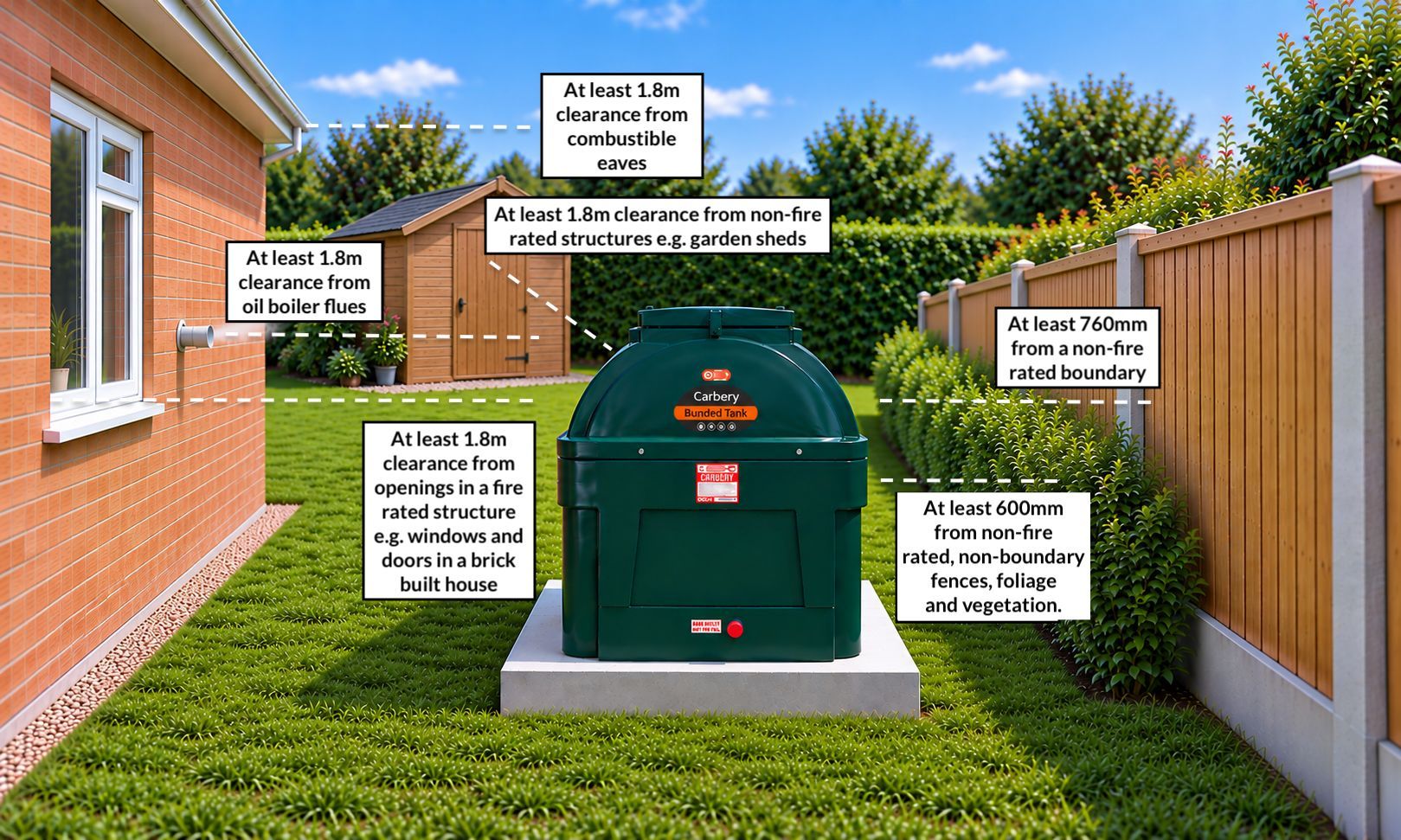
Minimum fire safety clearance distances for domestic heating oil tanks (i.e. tanks situated at a dwelling occupied by a single family and with a capacity of less than 3,500 litres). Image Credit: Author
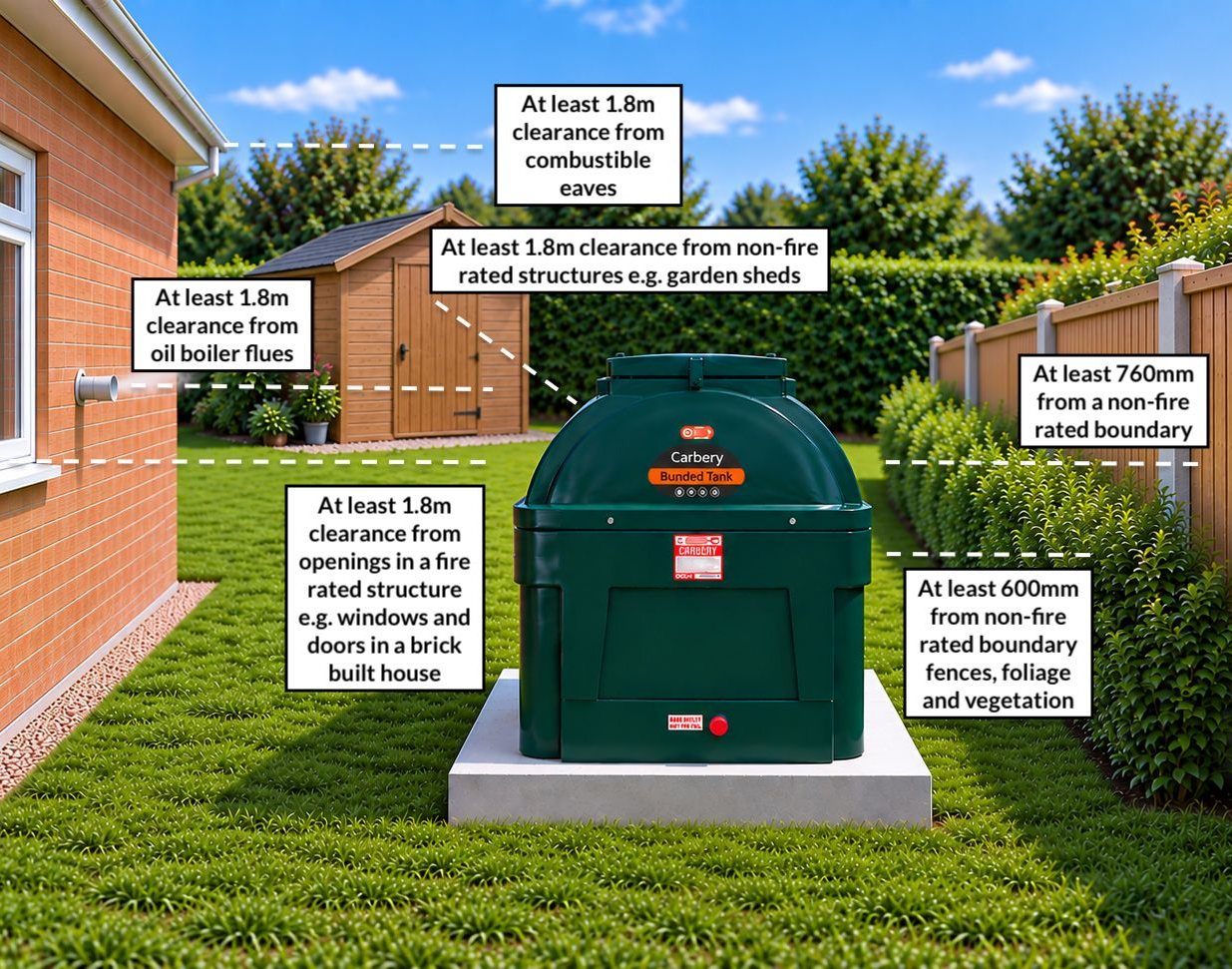
Minimum fire safety clearance distances for domestic heating oil tanks (i.e. tanks situated at a dwelling occupied by a single family and with a capacity of less than 3,500 litres). Image Credit: Author
Environmental Protection
A key part of any risk assessment, is to determine whether a bunded heating oil tank is required, or if a single skin tank can instead be fitted.
At almost all installations today, a bunded tank is mandatory. And even at the few, remaining installations where it remains permissible to install a single skin tank, we’d recommend serious consideration is always given to the installation of a bunded tank. Unlike a single skin tank, a bunded tank comprises a ‘tank within a tank’. The inner tank is the primary storage vessel, whilst the outer tank acts as a failsafe, in case of a spill.
To find out more about environmental protection requirements, and the benefits bunded tanks can provide, click or tap
here.
Base Construction
Like most things in life, to realise their potential, oil tanks need a firm foundation. Failure to base a tank correctly can cause irreparable damage, resulting in premature product failure and an environmental pollution incident. It will likely void any warranty supplied with the tank too
Heating oil tanks cannot be placed directly on to grass or tarmac.
Plastic tanks should be positioned on to a level, non-combustible base capable of supporting the weight of the tank when fully laden. The base should also extend a minimum of 300mm beyond the widest points of the tank, and support the underside of the tank in its entirety.

When installed correctly, tanks such as this Titan Bunded Heating Oil Tank can provide many years of reliable service. Image Credit: Author
When concrete slabs are used to support a plastic tank, they must be a minimum of 50mm thick.
Detailed base construction requirements exist for steel tanks too, but will vary according to tank design. Some steel tanks will require piers to be built to raise the underside of the tank off the ground. Other steel tanks are supplied complete with pre-fabricated ‘feet’ and are suitable for installation at ground level. Your local storage tank technician will be available to provide further guidance.


Going Underground?
We're often asked, ‘Can I place a heating oil tank underground?’ The simple answer is yes, you can – but:
- Any such installation is likely to prove far from straightforward;
- In many instances, an underground installation will prove expensive;
- At some installations, an underground tank will not be a viable option.
In general, underground heating oil storage installations should only be considered as a last resort, where aboveground storage is not a viable option. If, however, you remain undeterred, then there are 2 general approaches to underground heating oil storage:
- The first is to enclose an aboveground tank in a purpose designed, underground chamber. Consideration must be given to refuelling, venting and preventing the ingress of water;
- The second is to install a purpose designed, underground tank, engineered for direct burial – remembering that above ground tanks are inherently unsuitable for installation underground. Any such tank should be double-skinned and incorporate interstitial leak detection.
In either instance, you’ll need to consult either a suitably competent person e.g. APHC or OFTEC Registered Technician, for advice and guidance in advance of any installation. You may also require planning permission – permission which is not ordinarily required for an aboveground domestic heating oil storage tank. You should also remember that some fuel distributors may refuse to fill an underground storage tank; others may require a test certificate prior to the commencement of filling, to confirm the tank is in good condition and fit for purpose.
Indoor Installations
In the UK and Republic of Ireland today, most domestic heating oil is stored in tanks installed outdoors. And that’s pretty much been the case since the very first heating oil tank was installed. However, in some other countries, tanks are frequently installed internally e.g. in basements and cellars. So, is it possible to install a tank indoors in Great Britain or Ireland?
In principle, yes; you can - but it's not for the faint hearted. You'll need to ensure:
- The tank is afforded adequate secondary containment;
- The tank is installed within a chamber with a minimum 1-hour fire rating;
- The contents of the tank vent directly to atmosphere;
- The chamber contains nothing aside from the tank;
- The tank is positioned at the lowest possible level within the chamber;
- Adequate space is provided to allow the tank to be inspected and maintained.
Other detailed considerations apply. From experience, such installations can prove expensive and can be fraught with difficulty.
Before proceeding with any such installation, it’s essential to take professional advice, from a suitably competent person.
At the same time, you'll also wish to check with your home insurer that locating a tank indoors will not invalidate your home insurance policy or make it more difficult to obtain. And of course, you’ll also need to check with your fuel distributor they’re prepared to fill an internally sited tank. Some won't even consider it.
Finally, you should also be aware that not all manufacturers permit the installation of their products indoors, so it makes sense to check with the manufacturer before purchase.
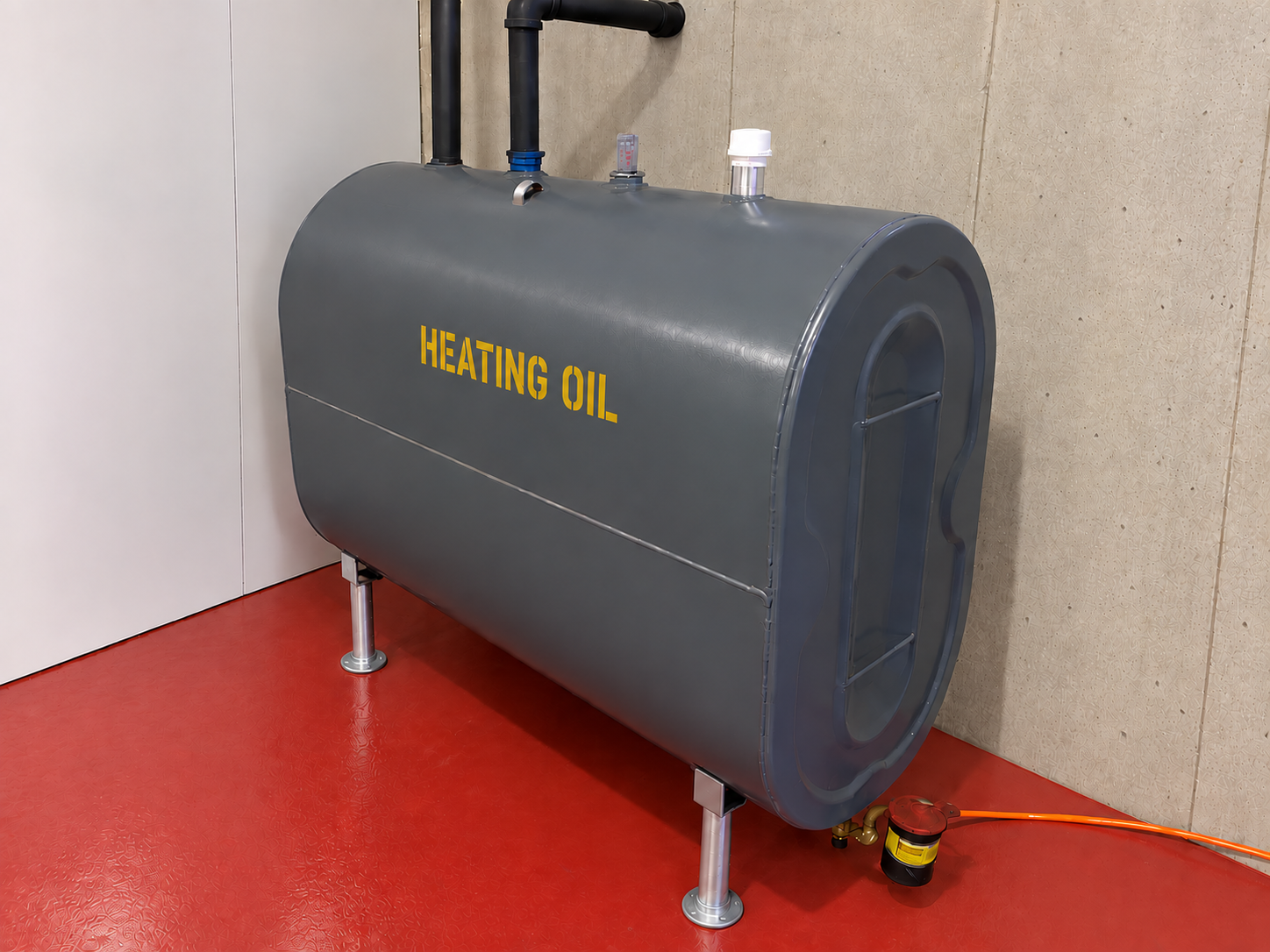
This basement 275 US gallon (1,041 litres) capacity heating oil tank is typical of many heating oil storage installations in North America, but an unusual sight in the UK and Republic of Ireland. Image Credit: Author
Our Take...
Oil tanks are not DIY products. Instead, they require professional installation. So, you’ll want to engage the services of a professional installer, registered with a competent persons’ scheme such as APHC or OFTEC. And whilst a tank can in theory be installed internally or externally, above the ground or below it… a straightforward, external, aboveground tank installation has much to commend it.
However, where this isn’t a viable option, then other installation arrangements do exist. Just don’t expect them necessarily to be simple, straightforward, or affordable.
Header Photo Credit: Pixabay.com